


Brazilian Leads World AI While Nano-Banana and Grok Democratize Creativity - Why This Historic Moment Redefines the Global Power of Technology
August 31, 2025 | by Matos AI
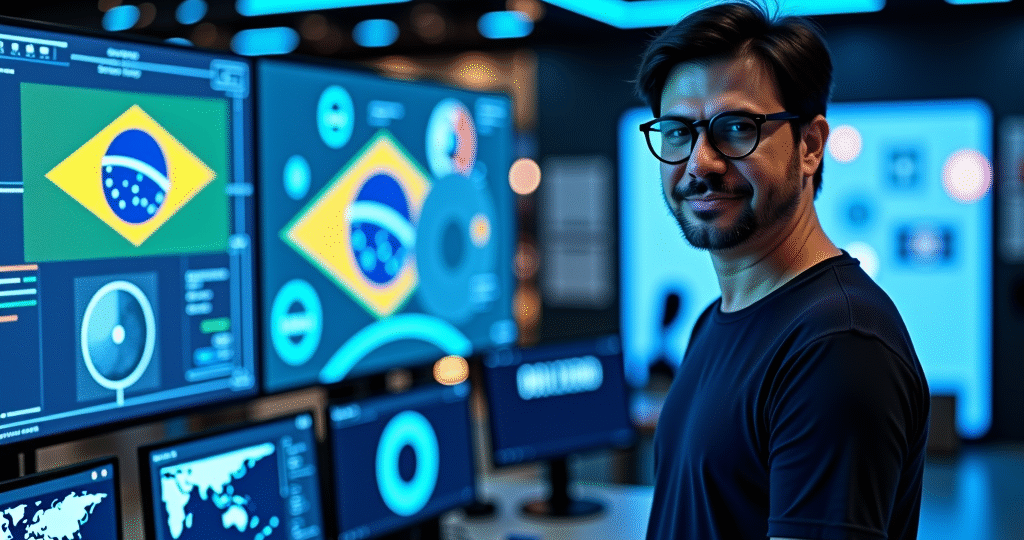
Three Brazilians on the list of the world's most influential people in artificial intelligence. One of them heads Qualcomm, the chip giant that powers the world's leading Android smartphones. Meanwhile, Google and Elon Musk are releasing free AI tools that used to cost thousands of dollars a month.
The last 24 hours weren't just another day in the world of technology. It was one of those moments that define decades.
Brazil's Moment in Global AI Leadership
When the Time magazine elects Cristiano Amon, Qualcomm's CEO as one of the most influential AI leaders in 2025, we're not just talking about individual recognition. We are witnessing Brazil taking a leading role in one of the most strategic sectors of the world economy.
Join my WhatsApp groups! Daily updates with the most relevant news in the AI world and a vibrant community!
- AI for Business: focused on business and strategy.
- AI Builders: with a more technical and hands-on approach.
Amon, an electrical engineering graduate from Unicamp, heads the company responsible for Snapdragon processors - the “brains” of the world's leading Android smartphones. Under his management, Qualcomm has invested heavily in AI, developing the chips that today make it possible to process artificial intelligence directly in our mobile devices.
But he's not alone. Mike Krieger, co-founder of Instagram and current director of Anthropic, and Ana Helena Ulbrich, CEO of No.Harm, which develops AI for medical safety, complete the internationally recognized Brazilian triad.
Why does it matter? Because it demonstrates that the Brazilian innovation ecosystem is already forming leaders capable of influencing decisions that affect billions of people globally.
The Accelerated Democratization of AI Tools
While we celebrate Brazilian recognition, a silent revolution is taking place in access to AI tools. O Google launches Gemini 2.5 Flash Image, The software, nicknamed “Nano-Banana”, allows professional image creation and editing by AI using simple commands.
At the same time, Elon Musk releases Grok Imagine for free on the X platform, democratizing access to tools that used to cost hundreds of dollars a month.
We are witnessing what I call “AI's Gutenberg moment” - when technologies previously restricted to elites become accessible to the masses. Remember when having a website cost thousands of dollars and today anyone can create one in minutes? Creative AI is following the same path.
What This Means for Business
For entrepreneurs and companies, this democratization represents a historic opportunity. Small startups now have access to the same visual creation tools as large agencies. Freelancers can compete with entire teams. The cost of producing visual content plummets.
But herein lies the paradox: the more accessible the tools become, the more important the human capacity to knowing what to create, not just how to create.
Geopolitical Chip Wars Reveal New Realities
Meanwhile, behind the scenes of global politics, a fascinating battle is unfolding. China continues to acquire advanced AI chips through secondary markets in India, Malaysia and Singapore, bypassing US sanctions.
This situation illustrates a fundamental truth: innovation always finds a way. Attempts to control technology through artificial barriers often accelerate the development of alternatives.
For Brazil, this represents both an opportunity and a warning. An opportunity because we can position ourselves as a technological bridge between different geopolitical blocs. A warning because we need to develop our own capacity for innovation in semiconductors and AI.
The Future is Human + AI, Not Human vs AI
One of the most valuable insights of the last 24 hours comes from an unexpected source: Vivaldi's decision not to incorporate generative AI into its browser. Its CEO, Jon von Tetzchner, argues that the motivation behind inserting AI into browsers is “more marketing than user benefit”.
This position, apparently contrary to the dominant trend, actually reveals a profound wisdom. Not every AI application adds real value. Human service is becoming a luxury precisely because it offers something that AI can't replicate: genuine empathy, emotional understanding and the ability to deal with complex nuances.
The Intelligent Application of AI
We see this brilliantly illustrated in using AI to discover talent in Brazilian soccer. Startups such as Germany's Cuju and Italy's Footbao are democratizing the access of young athletes to important clubs, eliminating geographical and socio-economic barriers.
Here, AI doesn't replace human scouts - it powers them, allowing them to identify talent on a global scale. It's the perfect collaboration between technological efficiency and human intuition.
iPhone 17 and the Next Adoption Cycle
The announcement of the iPhone 17 with iOS 26 marks the beginning of a new cycle in the mainstream adoption of AI. With features such as real-time translation of calls and FaceTime, integrated image generation and Visual Intelligence for interacting with on-screen objects, Apple is making AI an invisible part of the user experience.
This is the winning approach: AI that works behind the scenes, making technology more human, not more complex.
The Brazilian Moment and Practical Opportunities
Returning to the recognition of Brazilians as world leaders in AI, this is no coincidence. It's the result of decades of investment in technological education, the formation of a vibrant start-up ecosystem and, above all, Brazil's ability to look at technology through a humanized lens.
Cristiano Amon defines AI as “the new user interface”, pointing out that it allows computers to understand human language and perceive images and sounds. This user-centered vision, typical of the Brazilian approach to technology, is proving fundamental to global success.
How to Seize the Moment
For entrepreneurs and business leaders, this moment offers concrete opportunities:
- Low-cost experimentation: Use tools such as Nano-Banana and Grok Imagine to test creative ideas without large initial investments
- Differentiation through the human: While everyone is rushing to automate everything, invest in what AI can't replicate - genuine relationships and personalized experiences
- Strategic partnerships: The example of soccer shows how AI can democratize access to opportunities - which sectors of your industry could benefit from this approach?
- Global positioning: Brazil's international success shows that it is possible to compete globally from Brazil - use this as inspiration to think bigger
The Paradox of Intelligent Supervision
An article translated from The New York Review raises a provocative question: “Would AI be the new foreman?” The analysis suggests that AI may be functioning as an extension of the “master's eye”, extending supervision over the workforce.
This perspective reminds us of the importance of using AI in an ethical and empowering way. Technology should serve to enhance human potential, not to control or diminish people's autonomy.
In my work with startups, I constantly see the difference between companies that use AI to control and those that use it to empower. The latter invariably have better results in both productivity and staff satisfaction.
Final Reflections: Brazil at the Center of the Revolution
The last 24 hours have revealed something extraordinary: Brazil isn't just following the AI revolution - it's leading key aspects of it. From Cristiano Amon running the chip infrastructure that enables global mobile AI, to Brazilian startups being discovered by European AI tools in soccer.
But perhaps the most valuable insight is this: the future does not belong to those who master technology, but to those who know how to apply it in a humanized and purposeful way.
The democratization of creative AI tools, ethical dilemmas about intelligent supervision, and the growing importance of the human touch in an automated world - all point to a fundamental truth: we need leaders who understand both technology and people.
And apparently we're doing very well.
In my mentoring program, I help startups and business leaders navigate exactly these opportunities - combining the best of technology with human-centered strategies. Because in the end, the most powerful AI is the one that amplifies our humanity, not replaces it.
✨Did you like it? You can sign up to receive 10K Digital's newsletters in your email, curated by me, with the best content about AI and business.
➡️ Join the 10K Community here
RELATED POSTS
View all



 PT_BR
PT_BR EN
EN ES
ES AR
AR