


All blog posts
Insights on startups, AI, innovation, the future of work and technology education. Practical strategies for impact businesses and digital transformation.
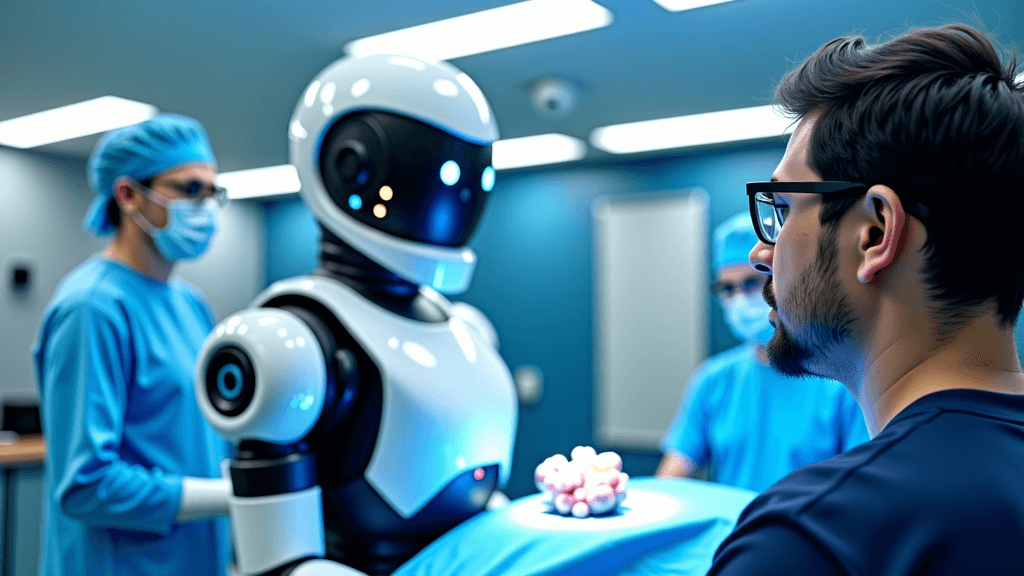





Yesterday was no ordinary day in the history of artificial intelligence. While I was writing about technological transformations, humanity witnessed the first AI-guided robot perform surgery entirely on its own, without any human intervention. At the same time, a Brazilian startup proved that we can be protagonists in this revolution, using AI to predict climate change with unprecedented accuracy.
These two milestones didn't happen by chance, and they reveal that we're experiencing an unprecedented acceleration in AI development—and this has profound implications for all of us, especially for those who shape the future through innovation.
The Historic Moment: When the Machine Single-Handedly Saved a Life
Researchers at Johns Hopkins University have achieved something that sounds like science fiction: a robot called SRT-H (Hierarchical Surgical Robot Transformer) performed eight gallbladder removals on human tissue without any assistance. According to Correio Braziliense, the system was trained with techniques similar to ChatGPT, but to understand anatomy and medical procedures.
What impresses me is not just the technical precision, but the real autonomy demonstrated. Unlike previous versions that followed rigid scripts, this robot made decisions in real time and adapted to unpredictable scenarios. As Axel Krieger, the project leader, put it: "It's a leap from robots that only perform tasks to robots that understand what they're doing."
This represents a fundamental shift in the relationship between humans and machines. We're no longer just automating repetitive tasks—we're creating systems that understand context, assess risk, and make critical decisions.
Brazil at the Forefront: MeteoIA and the Climate Revolution
While the world celebrated robotic surgery, a Brazilian startup demonstrated that we can also lead technological revolutions. MeteoIA, founded by Thomas Martin and Gabriel Perez, developed the first commercial AI system for climate prediction available on the market.
What makes this particularly relevant? Brazil loses billions annually due to extreme weather events. In 2024, agricultural production fell by 3.2% due to lack of rainfall, while rising temperatures increased energy consumption by 3.6%. MeteoIA offers forecasts with up to a year in advance, allowing companies to prepare adequately.
The case of Motiva (formerly CCR) is exemplary. The company uses MeteoIA's annual reports to plan maintenance projects, postpone interventions during periods of risk, and even evaluate acquisitions. Miguel Dau, the company's director, states that MeteoIA brought "knowledge that we, and the world, lacked."
Initially funded with R$ 2 million from FAPESP, the startup is now preparing a Series A round to expand commercially. It's a perfect example of how AI can solve real-world problems while generating significant economic value.
The Transformation of Healthcare: Beyond Surgery
Autonomous robotic surgery is just the tip of the iceberg. According to Forbes Brazil, 70% of global healthcare leaders have already adopted generative AI or are implementing the technology. In Brazil, 17% of doctors and 16% of nurses already use generative AI in their routines.
What strikes me is how AI is democratizing capabilities previously exclusive to highly trained specialists. Virtual assistants improve doctor-patient communication, systems automate documentation, and algorithms personalize treatments based on each person's unique data.
But there's a significant challenge: only 41% of healthcare facilities in Brazil use AI. This represents a massive opportunity for entrepreneurs who can connect advanced technology with real sector needs.
The Ethical Dimension: What the Pope Teaches Us
Amidst so many technical advances, Pope Leo XIV sent a crucial message for the Artificial Intelligence Summit in Geneva: “AI must go hand in hand with respect for human and social values.”
The Pontiff touched on a fundamental point: while AI can “simulate aspects of human reasoning and perform specific tasks with incredible speed and efficiency,” it “cannot replicate moral discernment or the ability to form genuine relationships.”
This reflection is especially relevant for us, entrepreneurs and innovation leaders. As we develop increasingly powerful solutions, we need to ensure they serve the common good, not just technical efficiency.
The Paradox of the Brazilian Judiciary
A worrying development is emerging in the Brazilian judicial system. According to the Legal Consultant, AI systems are being implemented to write court decisions, generating the “Zero Resource Project” paradox.
The logic is simple: if AI always makes the "correct" decision, why would there be appeals? But this raises profound questions about the role of human judgment in justice. As the article asks: "If a machine decides, and another in a higher court does the same, there would be no room for appeals."
This example shows how implementing AI without proper reflection can create seemingly efficient systems that eliminate essential elements of the human experience—in this case, the right to question and review.
Signs of Market Maturity
Other developments over the past 24 hours confirm the growing maturity of the AI market:
- Massive Investments: Meta invested US$100 million to hire AI experts, signaling the accelerated race for talent.
- Practical Applications: Resolva.AI demonstrates how AI can solve everyday problems, calling customer service centers and resolving consumer issues with a 87% success rate.
- Business Empowerment: Entrepreneurs Use AI to Take on CFO Roles, democratizing advanced financial capabilities.
What This Means For You
These developments aren't just technological curiosities. They represent the materialization of trends I've been observing for years: AI is moving beyond the lab to solve real problems, create economic value, and transform entire industries.
For entrepreneurs, this means that the window of opportunity is expanding rapidlyStartups like MeteoIA demonstrate that it's possible to compete globally with innovative solutions. The transformation of healthcare, changes in the judiciary, and the automation of customer service reveal entire sectors being redefined.
But there's also a warning: the speed of change requires us to think not just about technology, but also about human impact. The Pope's message, concerns about the judiciary, and the need to identify synthetic voices remind us that technological progress without ethical reflection can create more problems than solutions.
Building the Future Responsibly
We are living in a unique moment in history. The first autonomous robotic surgery and the success of MeteoAI are milestones our grandchildren will study in history books. But the true legacy will be determined by how we use these tools.
The question is no longer whether AI will transform everything—it already is. The question is: how can we ensure this transformation serves the common good, creates inclusive opportunities, and preserves what is most human in us?
In my mentoring work with startups and innovation leaders, I see that the most successful entrepreneurs are those who balance technological ambition with social responsibility. They understand that true innovation isn't just about creating something new, but about creating something better for humanity.
If you're building with AI, remember: you're not just developing a tool. You're helping write the next chapter of human history. May it be a chapter we can be proud of.
 PT_BR
PT_BR EN
EN ES
ES AR
AR